
Jump starting
To start your engine with a booster battery, the instructions and precautions below must be followed.
 WARNING
► If done incorrectly, jump starting can
lead to a battery explosion, resulting in
severe injury or death. It could also
damage your vehicle.
► Explosive hydrogen gas is always present
in the vicinity of the battery. Keep
all sparks and flames away from the
battery.
► Do not allow battery fluid to come into
contact with eyes, skin, clothing or
painted surfaces. Battery fluid is a
corrosive sulphuric acid solution which
can cause severe burns. If the fluid
should come into contact with anything,
immediately flush the contacted area
with water.
► Keep the battery out of the reach of
children.
► The booster battery must be rated at 12
volts. Use of an improperly rated battery
can damage your vehicle.
► Whenever working on or near a battery,
always wear suitable eye protectors (for
example, goggles or industrial safety
spectacles) and remove rings, metal
bands, or any other jewelry. Do not lean
over the battery when jump starting.
► Do not attempt to jump start a frozen
battery. It could explode and cause
serious injury.
► Your vehicle has an automatic engine
cooling fan. It could come on at any time.
Keep hands and other objects away from
it.
If needed, Roadside Assistance is available. Please see your Warranty Information Booklet or Roadside Assistance I.D. Card for the toll-free number to call (U.S.) or Warranty Information Booklet (Canada).
WARNING
Always follow the instructions below. Failure
to do so could result in damage to the
charging system and cause personal injury.
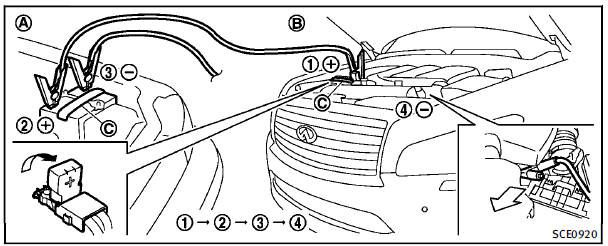
1. Remove the engine compartment cover, if necessary. See “Engine compartment check locations” in the “8. Maintenance and do-it-yourself” section. 2. If the booster battery is in another vehicle A , position the two vehicles (A and B ) to bring their batteries into close proximity to each other.
Do not allow the two vehicles to touch.
3. Apply parking brake. Move the selector lever to the P (Park) position. Switch off all unnecessary electrical systems (light, heater, air conditioner, etc.). 4. Remove vent caps on the battery (if so equipped). Cover the battery with a firmly wrung out moist cloth C to reduce explosion hazard. 5. Connect jumper cables in the sequence as illustrated (1 -2 -3 -4 ).
 CAUTION
► Always connect positive (+) to positive
(+) and negative (−) to body ground (as
illustrated) — not to the battery.
► Make sure the jumper cables do not
touch moving parts in the engine compartment
and that clamps do not contact
any other metal.
6. Start the engine of the booster vehicle A and let it run for a few minutes. 7. Keep the engine speed of the booster vehicle A at about 2,000 rpm, and start the engine of the vehicle being jump started B .
CAUTION
Do not keep the starter motor engaged for
more than 10 seconds. If the engine does
not start right away, push the ignition
switch to the OFF position and wait 10
seconds before trying again.
8. After starting your engine, carefully disconnect the negative cable and then the positive cable (4 - 3 - 2 -1 ). 9. Replace the vent caps (if so equipped). Be sure to dispose of the cloth used to cover the vent holes as it may be contaminated with corrosive acid. 10.Put the battery cover on.
See also:
Exterior
The QX looks a little like a guy I saw at the airport the other day who was
trying to squeeze in a few too many trends. (Really? Black, skinny emo jeans, a
handlebar mustache and a Mohawk? Choose on ...
Getting started
The following procedures will help you get started using the Bluetooth Hands-Free Phone System with INFINITI Voice Recognition. For additional command options, refer to “List of voice commands” in thi ...
Drinking alcohol/drugs and driving
WARNING
Never drive under the influence of alcohol or drugs. Alcohol in the bloodstream reduces coordination, delays reaction time and impairs judgement. Driving after drinking alcohol increases the ...